
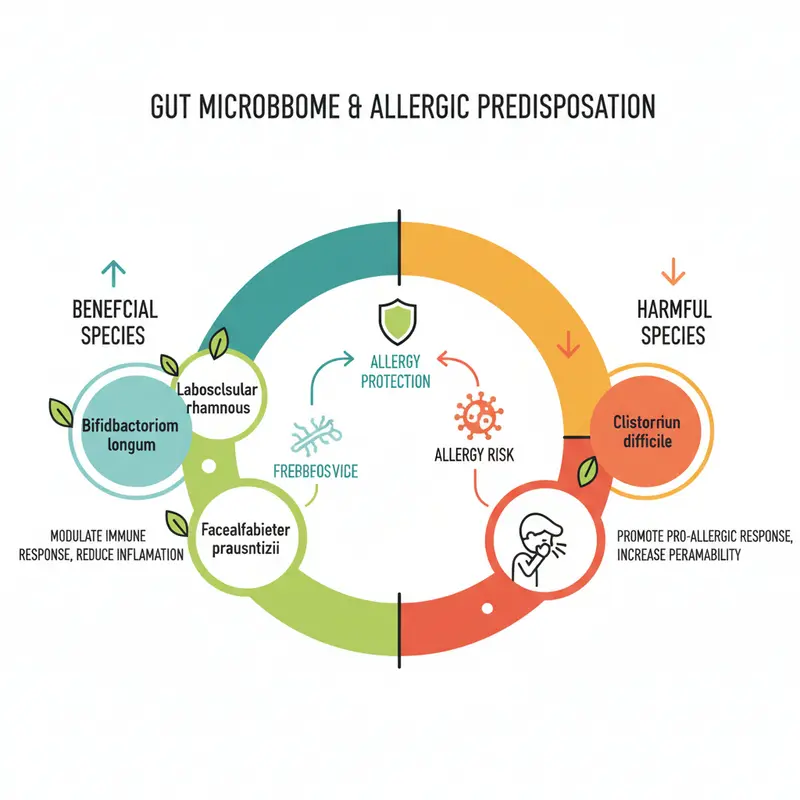
Key Gut Microbial Species Influencing Allergic Predisposition
Oh, friends, let’s be real. If you’re a parent, you know the constant worry about allergies. My little one, Leo, had such bad sniffles last spring, and it got me wondering: Is there something more we can do? That’s when I started diving into how gut microbiota shapes allergic predisposition. It turns out, understanding these tiny residents in our tummies is actually pretty key if we want to tackle allergies head-on. Now, I’m no scientist, but I’ve been learning a ton about the specific little bugs, what they make, and how they chat with our immune system. I want to share what I’ve learned, from one busy parent to another, so we can all feel a little more in control when it comes to our family’s allergy risk.
Okay, so let’s talk about the main players in our gut when it comes to allergies. It’s not just a general free-for-all down there; certain bacteria really influence how gut microbiota shapes allergic predisposition. Think of them as different team members, some cheering our immune system on, others causing a bit of a ruckus. We’ve got some amazing “good guys” like Bifidobacterium longum, Lactobacillus rhamnosus, and Faecalibacterium prausnitzii. These little superstars seem to protect us by helping our immune system learn to be more tolerant. On the flip side, some “trouble-makers” like Clostridium difficile and certain other bacterial strains often show up more when allergies are an issue, making allergy risk higher.
When scientists peek inside the guts of kids with allergies versus those without, they consistently find fewer of those amazing Bifidobacterium and Faecalibacterium in allergic kiddos. This tells us these bugs are super important for keeping our immune system balanced. Meanwhile, the grumpy Clostridium difficile tends to be more abundant in those with allergies, which makes sense since it’s known to stir up inflammation. Can you believe it? One study even found a whopping 40% decrease in Faecalibacterium prausnitzii in children who later developed eczema! That’s a huge clue for how gut microbiota shapes allergic predisposition, right?
So, what exactly do these good bacteria do? Well, scientists have discovered they produce special little helpers called short-chain fatty acids, or SCFAs for short. Think of these SCFAs, like butyrate and propionate, as friendly messengers. They’re made by our amazing Faecalibacterium and Bifidobacterium species. These messengers tell our immune system to “chill out” by promoting something called regulatory T cells. Basically, this helps our body build immune tolerance, so it doesn’t overreact to things it shouldn’t, which can seriously cut down on those hypersensitive allergy symptoms. And get this: experiments in labs show that butyrate even helps with a fancy process called histone deacetylase activity. It sounds complex, but it’s actually super crucial for keeping inflammation down and potentially preventing allergies!
Here’s where it gets really interesting: it’s not just about the type of bacteria, but which specific family member it is! For example, different strains of Lactobacillus rhamnosus can have very different powers. Some are much better at boosting IL-10 production—that’s a key anti-inflammatory protein that calms things down in our bodies. These subtle differences really impact how allergies might develop. This means we can’t just grab any probiotic off the shelf; we need to be smart and choose specific strains if we want to truly make a difference for allergy prevention.
Key Gut Microbial Species Linked to Allergic Predisposition
To make it a bit clearer, here’s a quick peek at some of the key gut microbial species and what they do for our predisposition to allergies.
| Species Name | Role in Allergy Modulation | Evidence Level | Reference Example |
|---|---|---|---|
| _Bifidobacterium longum_ | Promotes immune tolerance by enhancing regulatory T cells | High | PMC10255222 |
| _Clostridium_ species | Induces Treg cells and protects against allergy | Moderate | SCIE_S3021924001284 |
So, what’s the big takeaway for us parents? Our predisposition to allergies is super connected to the tiny world living in our gut—right down to specific types and even strains of bacteria. The “good guys” help our immune system stay calm and tolerant thanks to those little messengers they create. Meanwhile, the “trouble-makers” can really rev up our immune system, making us more prone to allergies. This tells me that if we can be really precise and target these key gut microbes, we might just unlock some incredible ways to manage and even prevent allergies effectively. It’s all about working with our inner ecosystem!
Microbial Species to Target in Allergy Modulation (Checklist)
If you’re curious about specific microbes to focus on, here’s a little checklist of promising ones for allergy modulation:
- _Lactobacillus rhamnosus_: High intervention potential supported by multiple clinical studies.
- _Faecalibacterium prausnitzii_: Moderate intervention potential with emerging clinical evidence.
It’s genuinely exciting to think about how gut microbiota shapes allergic predisposition! This connection opens up so many possibilities for personalized health strategies for our families. Just imagining how understanding these tiny bugs—which ones help build tolerance and which ones pump up our allergy risk—could totally change how we prevent and treat allergies? That’s pretty amazing, if you ask me. Here’s to happier, healthier guts for all our kiddos!
FAQ
Q1: How do gut microbes like Bifidobacterium longum help reduce allergy risk?
A1: These awesome bugs, like Bifidobacterium longum, are like little peacemakers! They create special compounds, remember those short-chain fatty acids? These help our immune system learn to be more tolerant. So, instead of overreacting, our bodies stay calm, which definitely helps reduce allergy risk.
Q2: Can probiotic supplements effectively modify allergic predisposition?
A2: Oh, that’s a big question! Some specific probiotics, especially certain strains of Lactobacillus rhamnosus, have shown real promise in studies. They seem to help our immune system respond better and even ease allergy symptoms. But here’s the kicker: it really comes down to finding the right strain, because not all probiotics are created equal when it comes to allergic predisposition.
Q3: Is there evidence linking increased Clostridium difficile with allergies?
A3: Yep, there absolutely is. When there’s more Clostridium difficile hanging around in the gut, it often leads to more inflammation. And that inflammation can totally crank up our predisposition to allergies and make those immune reactions even more intense.
Q4: What role do microbial metabolites play in allergy development?
A4: Think of those microbial metabolites, like butyrate, as little choreographers for our immune system. They help guide key immune processes—including that fancy histone deacetylation thing—to keep inflammation down. This helps our bodies build tolerance, which is super important for preventing allergies from taking root.
Efficacy of Probiotics in Irritable Bowel Syndrome: Systematic Review and Meta-analysis.
The relative risk of experiencing any adverse event, in 55 trials, including more than 7000 patients, was not significantly higher with probiotics.